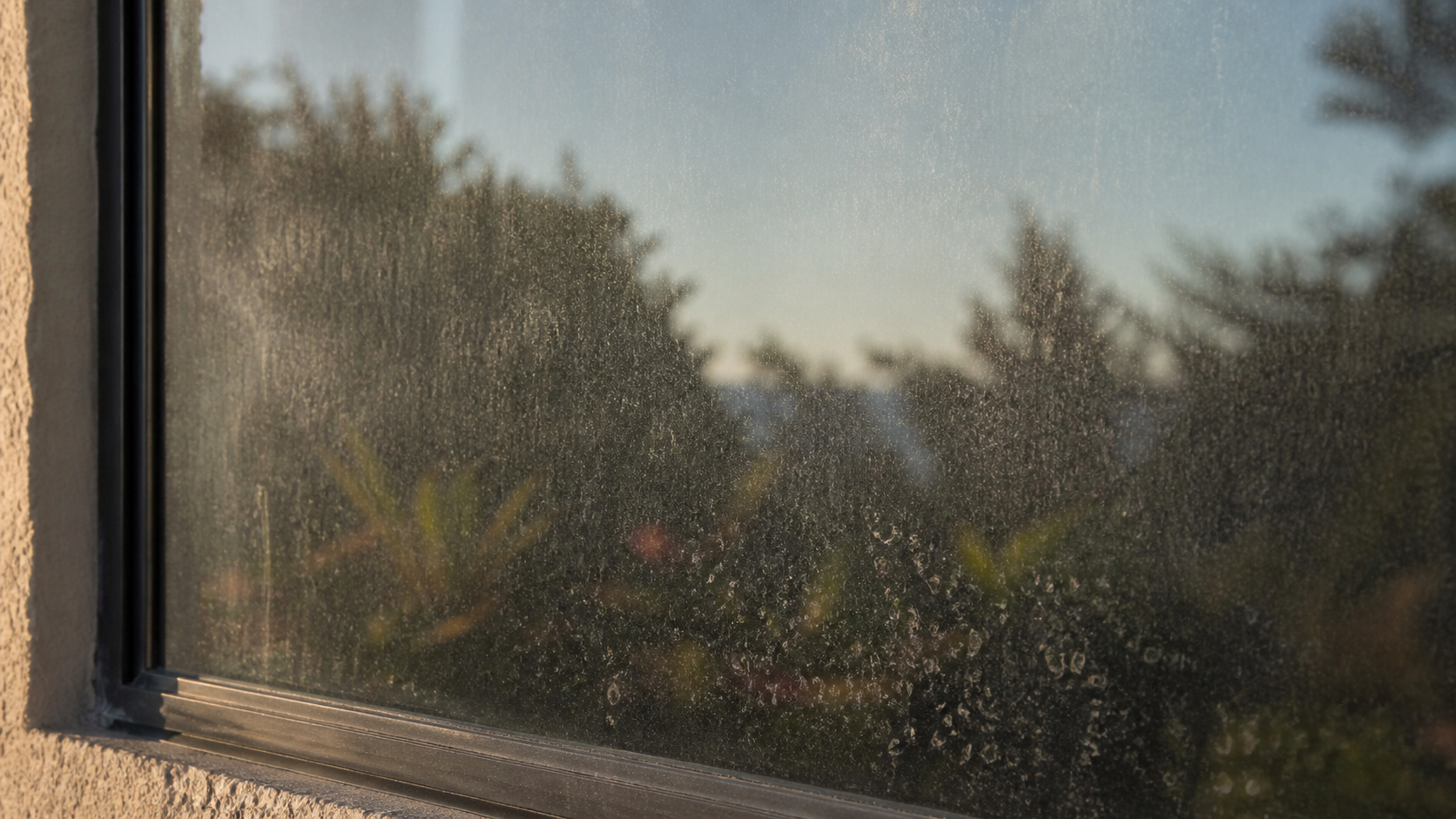
Salt Film or Hard-Water Spots? What Is Clouding Your Windows?
Afternoon light can make a coastal window look as if someone wiped it with a dirty cloth. In Los Osos or Morro Bay, salt film is a reasonable suspect. It is not the only one. Dried sprinkler water can leave mineral spots, and a cloudy patch sealed between two panes is not on either cleanable surface.
Before you scrub harder, find out where the haze is. That first step can save a lot of wasted cleaning.
Start by Finding Which Surface Is Cloudy
Choose one window you can reach safely from the ground. Look at it from inside and outside, then clean a small patch on each side with an ordinary glass-safe method. A useful trick is to wipe in different directions on the two sides. If a mark runs with your wipe, you know which surface you are looking at.
If the outside patch clears, the problem is on the exterior. If the inside patch clears, it is indoors. If neither changes the cloudy area, stop treating it like normal surface dirt.
On double- or triple-pane glass, haze can sit inside the insulated unit. Marvin says fogging or residue between insulated panes indicates a failed seal and cannot be cleaned from the outside. Cleaning the room side will not reach it either. That window needs an assessment from the window manufacturer or a window repair or replacement specialist, not repeated glass cleaning.
Salt Film Usually Looks Broad and Uneven
Homes around Cayucos, Cambria, Morro Bay, and Los Osos receive different amounts of ocean exposure, even within the same neighborhood. The side facing open coastal weather may look hazier than a protected courtyard window.
The source is real. Peer-reviewed coastal aerosol research explains that breaking waves and bursting bubbles release seawater droplets into the atmosphere. Some of that airborne material can settle on exposed surfaces.
On glass, suspected salt film is more likely to read as a fine, uneven veil across a wider area than as a collection of neat circles. It may show most clearly when low sun hits the pane. That pattern is a clue, not proof. Dust and ordinary grime can mix into the same film.
Try the small clean patch first. If ordinary glass-safe cleaning removes the veil and the view through that patch looks clear, you are dealing with removable surface buildup. If it stays cloudy, do not assume more pressure is the answer.
Hard-Water Spots Follow Where Water Dried
Mineral deposits tend to follow a water source. Look for round spots, overlapping droplet marks, drip paths, or a band that lines up with sprinkler reach. Hose spray and repeated runoff can leave a similar map. A window can have coastal film higher up and mineral spotting near the bottom at the same time.
The U.S. Geological Survey defines water hardness mainly by dissolved calcium and magnesium and notes that hard-water residue can appear as spots or film on glass. When droplets dry, the water leaves and the minerals remain.
This is why the pattern matters. Broad haze on the weather-facing side points you toward airborne exposure. Distinct spots directly above an irrigated planting bed point you toward water landing on the pane. Neither visual test can tell you whether the glass has permanent damage. It only gives you a better starting point.
USGS explains that vinegar’s acidity helps dissolve mineral particles, but that is not permission to put a homemade mix on every window. Coatings, tint, frames, seals, and manufacturer instructions still matter.
Try One Safe Test, Not an Aggressive Experiment
Work on a shaded, cool window you can reach without a ladder. Start by wetting the test area so loose grit is not dragged across dry glass. Use a clean, non-abrasive cloth and a cleaner approved for that window. Rinse or remove the solution before it dries.
Marvin’s care guidance says to soak glass with clean water first, use a non-abrasive applicator, and avoid abrasives, metal contact, and scrapers. The manufacturer also advises checking the instructions for treated glass, including low-E coatings.
Skip razor blades, abrasive pads, and a stronger-chemical guessing game. A tool that seems harmless on plain untreated glass may be wrong for a coated product or the parts around it. If your window manual gives a specific cleaning method, follow that rather than a general internet recipe.
Then let the test patch dry and view it from more than one angle. If the patch is clear, you have learned that cleaning can remove at least that surface layer. If the same milky area remains, more scrubbing may add risk without answering the diagnosis.
Know What Window Cleaning Can and Cannot Fix
Professional residential window cleaning can remove ordinary dirt and removable exterior film. It can also give you a clearer assessment of whether a stubborn mark is sitting on the accessible glass. The condition and requested scope still matter, as we explain in our guide to window cleaning cost in SLO County.
Cleaning does not repair a failed insulated-glass seal. It also should not be sold as a guaranteed cure for etched glass or permanent damage. Sometimes the honest result of an assessment is that the cloudiness is not a cleaning problem.
If ordinary glass-safe cleaning does not remove the haze, or you cannot tell which surface it is on, request a free estimate or call (805) 801-7800.